
Insights / Cyber Library
Thinking, Fast and Slow
The book AI researchers keep citing, worth reading firsthand instead of secondhand.
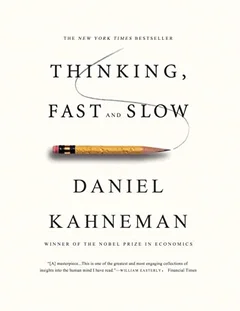
Thinking, Fast and Slow is not a new book, and it is not about AI at all. It belongs in this library anyway, because the AI researchers who write the books that are about AI keep citing it. Understanding how human judgment actually works turns out to be essential background for anyone building or evaluating systems meant to model or replace that judgment.
Daniel Kahneman earned his PhD in psychology from Berkeley and won the Nobel Prize in Economics in 2002, an unusual achievement for a psychologist. He taught as Emeritus Professor of Psychology at Princeton until his death in 2024. His career was built on questioning comfortable assumptions about how the mind works.
The book splits human thinking into two systems: a fast, intuitive one and a slow, deliberate one. From there it moves through heuristics and biases, overconfidence, and the choices people make under uncertainty. Readers will come away with a working vocabulary for concepts like anchoring, availability, and the illusion of validity. Those terms show up constantly in discussions of how both humans and AI systems make mistakes.
At nearly five hundred pages this looks intimidating, but the writing stays clear and full of memorable examples throughout.
Recommended as required background for anyone working on or with AI systems, and for general readers curious about the mechanics of their own judgment. Security and compliance professionals will recognize their own decision-making blind spots on nearly every page.
Originally published in ISSA Journal’s "The Cyber Library" column, January-February 2026 issue, by Jay Carson, Semper Sec’s Cyber Librarian. Read more at issa.org.
Start with the program, not the framework.
Talk with a senior advisor about the decisions, ownership, and operating capability your organization needs next.
A conversation with a senior practitioner, not a sales gatekeeper.