
Insights / Cyber Library
AI Ethics: A Textbook
A philosopher, not a technologist, asks whose values an AI system actually encodes.
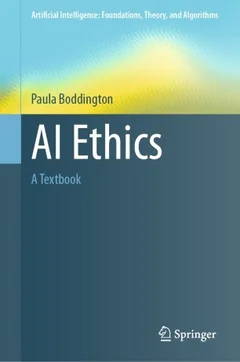
AI Ethics: A Textbook asks a question every AI professional eventually runs into. Whose values does an AI system encode, and who decided those values counted? Paula Boddington spends over five hundred pages working through that question with the rigor of a trained philosopher. Too much AI ethics writing settles for hand-waving instead.
Boddington holds a PhD and researched at Oxford before serving as an Associate Professor of Philosophy and Healthcare at the University of West London. She is not a technologist, and the book is better for it. Her healthcare and dementia care examples ground abstract ethical arguments in decisions real clinicians and caregivers actually face. That gives the philosophy teeth that purely technical AI ethics writing usually lacks.
The chapters move from the rise of AI ethics as a field through the philosophy of technology and applied ethics methods. They close on persons, society, and AI’s future. The Tay chatbot failure and the MIT Moral Machine experiment both get serious treatment as case studies, not throwaway examples.
This book earns a permanent place on the shelf, not a one-time read. The glossary alone is worth keeping close at hand for anyone who needs precise language when a values question comes up in an AI project.
Recommended for AI professionals who want a serious ethics grounding instead of a surface-level conversation. Privacy practitioners will especially value her treatment of healthcare ethics.
Originally published in ISSA Journal’s "The Cyber Library" column, September-October 2025 issue, by Jay Carson, Semper Sec’s Cyber Librarian. Read more at issa.org.
Start with the program, not the framework.
Talk with a senior advisor about the decisions, ownership, and operating capability your organization needs next.
A conversation with a senior practitioner, not a sales gatekeeper.